What is NRR in Cricket? The Math That Decides Tournament Winners
Group stages in tournaments like the World Cup or IPL often end with several teams sitting on equal points. Wins and losses look the same on paper, but only some teams move forward. At that stage, rankings depend on a secondary factor that decides everything.
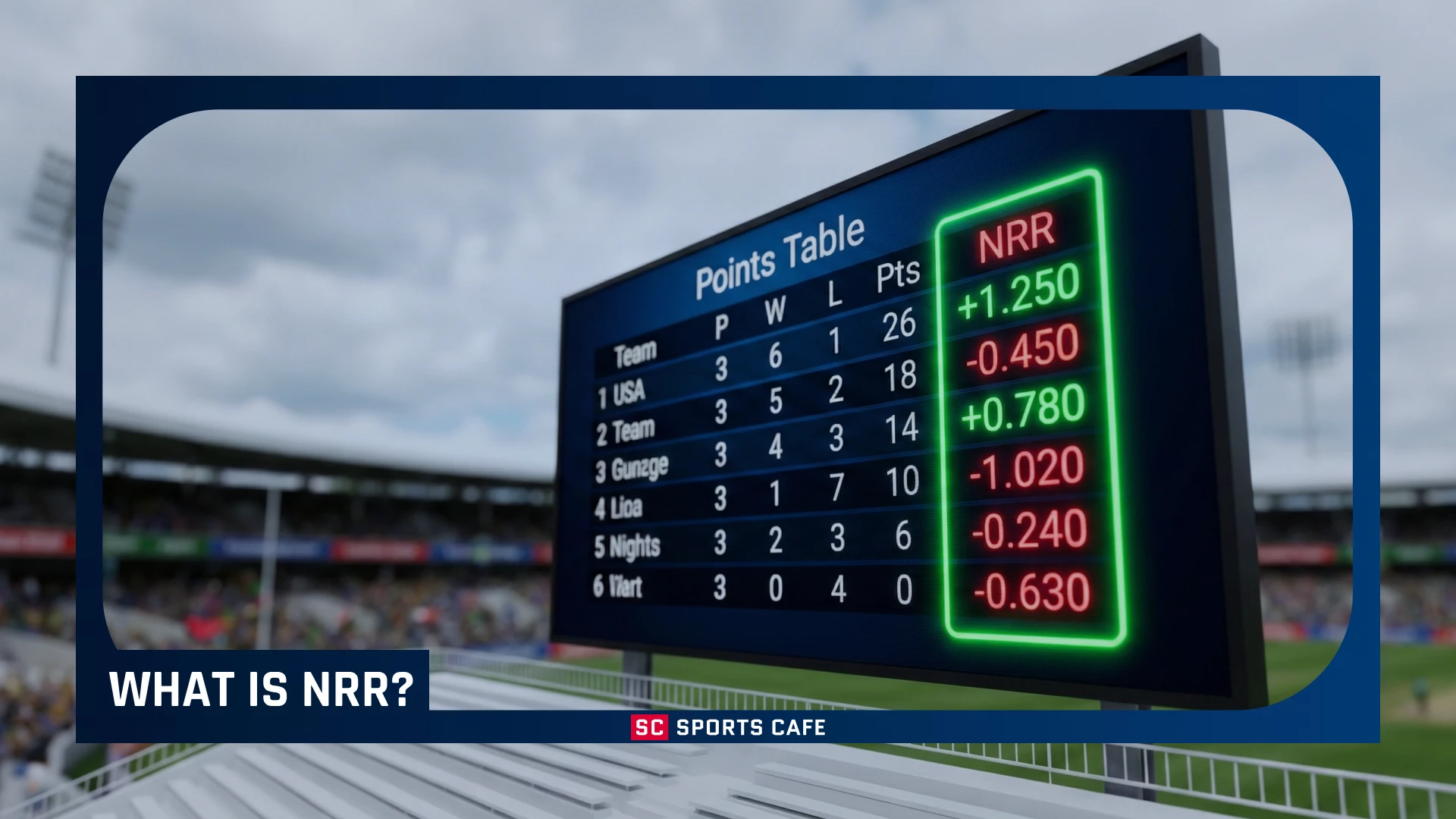
That factor is Net Run Rate. For anyone checking the table and feeling confused, NRR full form in cricket stands for Net Run Rate. It is a statistical measure that compares how quickly a team scores runs with how quickly it concedes them across the whole tournament. The number reflects both batting strength and bowling control, not just single-match results.
NRR also follows strict rules that many fans miss. One of the most important is the All Out rule. When a team loses all its wickets before using its full overs, the calculation still counts the entire quota of overs. That detail can damage NRR badly and often explains sudden drops in the standings.
In this guide, you will see NRR calculation explained through clear examples, understand how the All Out rule changes numbers, and learn why a difference of just 0.1 can decide a semi-final spot at the end of a league stage.
NRR Meaning in Cricket: Definition and Purpose
Net Run Rate exists to solve a common problem in tournament cricket. During group stages, teams often finish with the same number of points after winning and losing the same number of matches. When that happens, organizers need a fair way to rank sides without replaying games. NRR fills that role by judging how well a team performed across every over it played, not just the final result of each match.
Instead of focusing only on wins, this metric looks at scoring speed and control. Teams that dominate matches across long periods usually rise above those that survive close finishes. Because of that, NRR carries real weight in modern competitions.
What is the Full Form and Definition?
NRR stands for Net Run Rate, and the NRR meaning in cricket comes down to a balance between scoring and control. The figure compares how fast a team scores its runs with how fast opponents score against its bowling, and the difference between those two rates forms a single value.
Tournament tables use this number as the primary separator when teams finish on equal points. A higher NRR places a team above its rivals, which rewards strong batting and disciplined bowling across the full competition rather than one isolated result.
Why is NRR Used in Tournaments?
Points alone do not tell the full story of a tournament. A team may win two matches by one run and lose another heavily, while another side wins one match by a huge margin and loses narrowly twice. NRR helps separate those cases by adding context to results.
The system encourages teams to keep pushing even after gaining an advantage. Batting sides aim to finish chases quickly, while bowling sides try to limit damage even in losing causes. Strong margins and efficient chases improve standings, which creates a competitive tone across every match and every over.
Positive vs. Negative NRR
NRR appears in standings with a plus or minus sign, and that detail matters. A positive value means a team scores faster than it concedes across the tournament. Such teams usually sit higher in the table when points match. A negative value shows that opponents score more freely, which often drops a team below its rivals despite similar win records.
Margins can be narrow. A difference of 0.05 or even 0.01 has ended campaigns in major events. Because of that reality, teams track NRR closely during the final rounds, and fans often calculate scenarios long before the last match ends.
How is Net Run Rate Calculated? The Formula
Net Run Rate often looks confusing because it combines data from many matches into one figure. The logic stays consistent across tournaments. Every run scored and every over faced gets counted together, not match by match. The same rule applies to runs conceded and overs bowled. Once those totals exist, the calculation becomes clear and repeatable.
NRR does not reward one explosive performance on its own. A team needs balance across the full group stage. One heavy defeat can drag the number down, while a dominant win can lift it, but only through its effect on total runs and total overs.
To keep the process clear, the calculation always follows the same structure.
Component
Calculation
Purpose
Batting Run Rate
Total Runs Scored ÷ Total Overs Faced
Measures scoring speed
Bowling Run Rate
Total Runs Conceded ÷ Total Overs Bowled
Measures scoring speed against you
Net Run Rate
Batting RR − Bowling RR
Shows the difference
The NRR Formula Breakdown
The full formula reads as follows:
NRR = (Total Runs Scored / Total Overs Faced) − (Total Runs Conceded / Total Overs Bowled)
Every match in the tournament feeds into these totals. Scores from abandoned games do not count, but completed matches always do. Because of that structure, teams often adjust strategy late in the group stage when qualification depends on decimals rather than wins alone.
Step 1: Calculating Batting Run Rate
The first part focuses only on batting output.
Example values:
Total Runs Scored: 1800
Total Overs Faced: 200
Batting Run Rate = 1800 ÷ 200 = 9.00
That figure means the team scored an average of 9 runs per over across all matches played. It reflects consistency more than flair, since one fast innings cannot compensate for several slow ones.
Step 2: Calculating Bowling Run Rate
The second part measures how well the bowling unit restricted opponents.
Example values:
Total Runs Conceded: 1700
Total Overs Bowled: 200
Bowling Run Rate = 1700 ÷ 200 = 8.50
Opponents scored 8.50 runs per over on average. Strong bowling spells, even without many wickets, help keep this number low across the tournament.
Step 3: The Final Subtraction
At this stage, both required figures are already prepared. The last action focuses only on comparing them.
First, take the Batting Run Rate calculated from all matches.
Second, take the Bowling Run Rate based on runs conceded across the same games.
Third, subtract the bowling figure from the batting figure.
Using the running example:
Batting Run Rate = 9.00
Bowling Run Rate = 8.50
Now apply the calculation: 9.00 − 8.50 = +0.50
That final value represents the team’s Net Run Rate. A positive number means the team scores faster than its opponents do against them. Even a difference of 0.01 can decide rankings, so teams often pay attention to every over and every run near the end of a group stage.
Crucial Rules and Exceptions in NRR Calculation
Net Run Rate looks neat on a points table, but several rules quietly change how the numbers behave. Many fans miss these details, then feel confused when standings shift after a single match. Three situations matter most, and each one can swing a tournament.
The "All Out" Rule
The all-out rule causes the biggest shock. When a team loses all ten wickets before using its full allocation of overs, the calculation still assumes the complete quota. In a T20 match, a side dismissed in 15 overs gets treated as if it batted for all 20. Those unused overs do not disappear. They stay in the formula and stretch the denominator.
That rule punishes collapses very harshly. A team might score at a decent pace early, then lose wickets quickly, and still suffer a major drop in NRR. The logic stays clear: losing all wickets shows failure to manage resources, so the math reflects that mistake. Captains often remind batters to survive even in hopeless chases, since every extra over faced can soften the damage.
Rain-Affected Matches and the DLS Method
Weather introduces another layer of adjustment. When rain shortens a match, and officials apply the DLS method, the original match structure no longer matters. The revised target and the reduced number of overs become the only reference points for NRR.
Runs scored get measured against the overs actually available, not the planned total. A team chasing under DLS can gain or lose NRR faster than usual, since fewer overs magnify each run. Small margins carry extra weight in these matches, which explains why teams sometimes keep attacking even after victory feels safe.
Abandoned Matches
A match with no result stays completely outside the NRR system. Runs, overs, wickets, none of it counts. Points still get shared, but the statistics vanish from the tournament math.
That exclusion protects fairness. One side should not gain or lose ranking due to conditions that prevent a contest. As a result, teams often prefer a washed-out match to a heavy defeat, since a bad loss would drag NRR down for the rest of the group stage.
Net Run Rate in Strategy: Chasing and Defending
Net Run Rate rarely stays in the background during long tournaments. Captains, coaches, and analysts track it from the first week, since one strong or weak performance can decide qualification. Match plans often change once teams understand how many runs or overs matter, not only who wins.
Improving NRR While Batting First
When a team bats first, the focus shifts toward building distance on the scoreboard. A defendable total matters, but margin matters just as much. Each extra run scored adds directly to NRR if the opposition fails to match it.
Captains often push for late acceleration instead of settling after reaching a “safe” score. Finishing an innings at 185 instead of 170 may not change win probability much, but it can lift NRR noticeably. Bowlers then aim to restrict the chase as tightly as possible. Dismissals help, but dot balls and slow overs matter just as strongly. Winning by 25 or 30 runs carries far more value than a narrow defense.
Improving NRR While Chasing
Chasing creates a different set of priorities. The target stays fixed, so overs become the main weapon. Finishing early boosts NRR sharply, especially in limited formats.
Teams often calculate an internal par point. If the chase looks comfortable, batters receive instructions to maintain pace rather than protect wickets. Reaching the target with five overs unused improves NRR far more than crossing the line in the final over. That logic explains aggressive chases late in group stages, even when the required rate already looks manageable.
The Qualification Scenarios
NRR becomes most visible during the final matches of a league stage. Teams sometimes receive clear instructions tied to overs and balls. A message like “win inside 14.3 overs” comes from direct calculation, not guesswork.
Analysts start with the current NRR gap between the two teams. They then estimate how many runs or overs can close that gap based on the match format. Each ball faced or saved changes the decimal slightly. Players may not see the full math, but captains communicate the target clearly. That pressure creates unusual endings, where teams continue attacking after victory looks secure, simply because tournament survival depends on the final digits.
Real-World Examples of NRR Drama
Net Run Rate has decided some of the most dramatic moments in cricket history. Teams often find themselves fighting for survival or chasing an unlikely finish, not just to win a game, but to climb the table by tiny decimals. These examples show how maths and pressure can collide in a single match.
Mumbai Indians vs Rajasthan Royals (IPL 2014)
The 2014 IPL produced one of the clearest examples of NRR deciding fate. Mumbai Indians reached their final league match knowing that a win alone would not be enough. The Rajasthan Royals had already set a high benchmark on net run rate. Rajasthan scored 189 for 4, which gave Mumbai a target of 190. The real challenge came from the condition attached to it. Mumbai had to reach that score within 14.3 overs to move ahead on NRR.
Every run and every ball mattered. Corey Anderson attacked early, while Ambati Rayudu kept the chase stable. Even with victory almost secure, the required overs remained the real opponent. On the final delivery, Aditya Tare hit a full toss for six, ending the chase inside the exact window needed. Mumbai advanced to the playoffs, while Rajasthan went out, all because of fractions in net run rate.
World Cup Scenarios
World Cups have repeatedly shown the same pattern. Teams often end group stages with identical records, leaving NRR as the deciding factor. In the 2019 Cricket World Cup, New Zealand progressed to the semi-finals ahead of Pakistan despite equal wins, with net run rate acting as the separator. Similar pressure returned in the 2023 edition, where New Zealand’s stronger NRR placed them ahead in a crowded qualification race, forcing Pakistan into unrealistic scenarios that required extreme margins to recover the deficit. These moments highlight how teams must think beyond simple wins. Run margins, overs used, and tempo across an entire tournament often carry more weight than a single result, with tiny decimal differences deciding who advances and who exits.
FAQs about Net Run Rate in Cricket
What is the full form of NRR?
NRR stands for Net Run Rate, and the question what is the meaning of NRR in cricket relates to how teams are ranked when points are equal. It compares scoring speed with the rate at which runs are conceded across the tournament.
Does winning by wickets affect NRR?
Yes, but only through overs used. To understand what is meant by NRR in cricket, the key lies in how fast a chase finishes, since fewer overs raise the batting run rate.
How is NRR calculated if a team is all out?
When a side loses all wickets before completing its overs, the calculation still counts the full quota, such as 20 or 50 overs. That rule often causes a sharp drop in the final figure.
Can NRR be negative?
Yes. A negative value appears when opponents score runs faster against a team’s bowling than that team scores while batting.
Is Super Over included inthe NRR calculation?
No. Runs scored in a Super Over do not count toward standings, so what is net run rate in cricket IPL or any other league table always excludes those figures.
0
0
0
0
0
0
Comments
0/1000
Sign up or log in to your account to leave comments and reactions





Comments
Sign up or log in to your account to leave comments and reactions
0 Comments