What is Chucking in Cricket? Meaning and Illegal Actions Explained
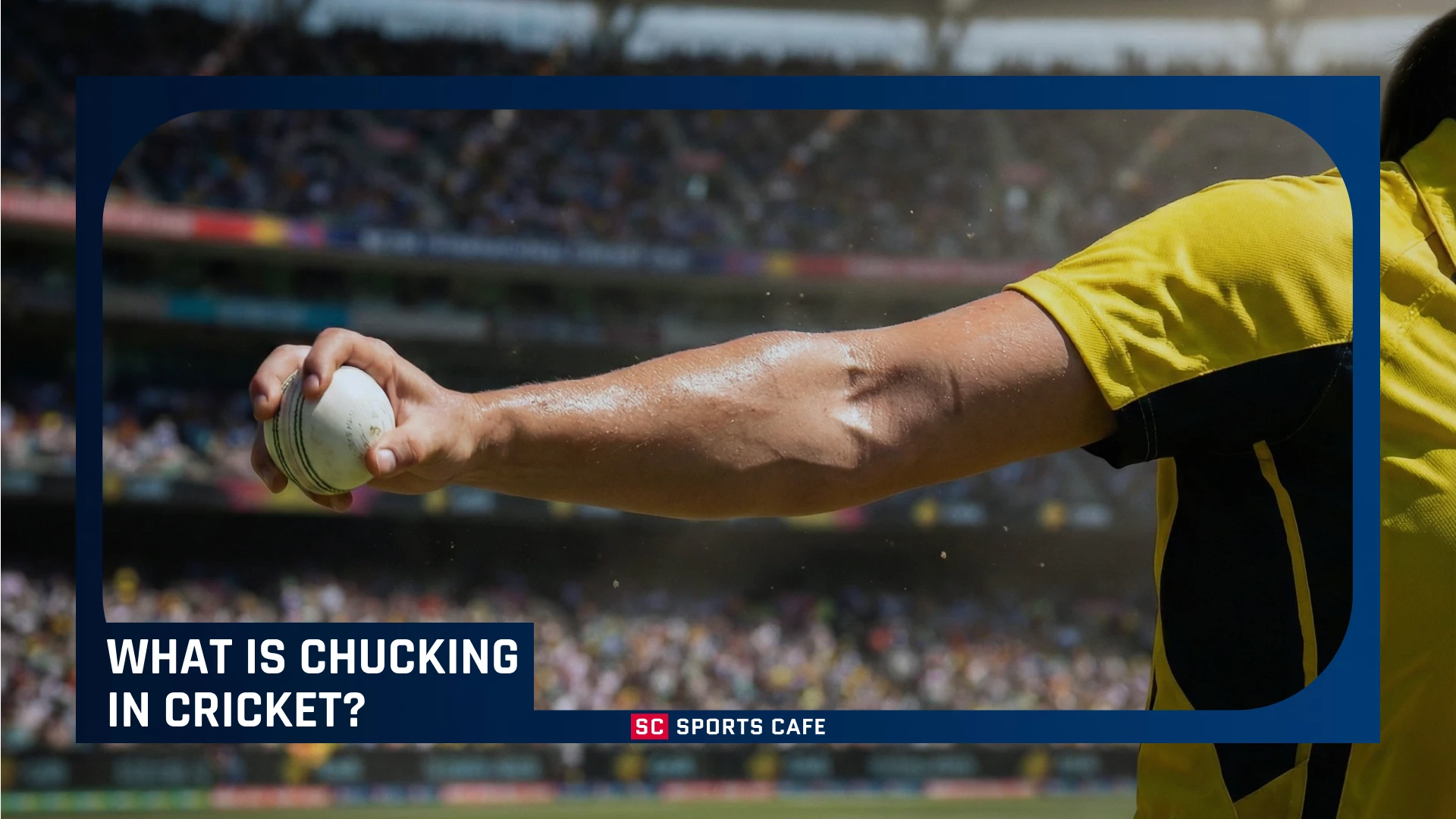
Nothing triggers debate in cricket faster than a moment when a bowler gets accused of chucking. Crowds react instantly, players argue their case, and commentators rush to analyse slow-motion footage frame by frame. Many fans search for clarity around what is chucking in cricket, because the term sits at the heart of discussions about fairness, biomechanics, and the limits of legal bowling. Chucking refers to a throwing action rather than a bowling action. It happens when a bowler straightens the arm at the elbow during the release of the ball. That movement is considered an illegal bowling action and violates one of the oldest principles of the sport. ICC introduced clear standards to remove confusion and protect fairness, which are essential topics for those engaged in online cricket betting. The article below breaks down the rule, explains how chucking is detected, and reviews the most famous controversies in cricket’s history.
What is Chucking?
A bowler’s action forms one of the foundations of cricket, and the difference between a legal delivery and an illegal throw comes from how the arm works during release. The idea behind a legal action is fairly direct: the shoulder acts as the main point of rotation, the arm moves in a smooth arc, and the elbow keeps the same angle from the start of the delivery stride until the ball leaves the hand. The release depends on the wrist and forearm, not on a push created by elbow movement.
The pattern changes as the elbow begins to straighten during arm forward motion. In that moment, the bowler produces a throw instead of a true bowling action. The extra force from the extension alters the result, and the ball gains more speed and sharper deviation than a legal action normally produces. That is why chucking a ball in cricket is treated as an illegal method and why the sport places strict controls on it.
Why is Chucking Illegal?
Chucking is banned because it grants an unfair advantage. The elbow extension generates power similar to a baseball pitch, which alters the nature of the contest between bat and ball. The Laws of Cricket treat that extension as an illegal delivery method. Law 21 states that the arm must remain in a fixed position from the moment the bowling arm rises until the ball is released. Any visible straightening triggers suspicion, and the action may be referred for formal assessment.
Chucking Rule and Legal Limits (The 15-Degree Rule)
ICC faced decades of disputes about what counts as a throw. Slow-motion footage revealed that even bowlers with completely natural actions showed minor elbow movement due to human biomechanics. Extensive testing in laboratories proved that every bowler has some degree of elbow extension. The solution was a universal limit for all types of bowlers: seamers and spinners.
The 15-degree limit became the decisive benchmark. A bowler may legally extend the elbow up to 15 degrees during the delivery. Anything above the limit is illegal. The figure is not random. Biomechanical research showed that humans cannot naturally detect elbow extension under 15 degrees with the naked eye. The rule, therefore, creates a balance between scientific accuracy and practical umpiring.
The Evolution of the Rule: From the Naked Eye to the 15-Degree Limit
Cricket once tried to enforce a zero-degree rule, which meant any elbow movement was illegal. That proved impossible to apply because umpires could not detect microscopic movement during live play. Technology changed the landscape. High-speed cameras and motion-capture sensors revealed that nearly all bowlers extend the elbow slightly. ICC moved from subjective judgment to measurable limits, and the 15-degree standard replaced decades of controversy.
How Chucking is Detected and Penalised
Umpires, match referees, and ICC biomechanics specialists all play a role in the process. A suspected action follows several key steps that often lead to major shifts in match predictions.
Before the steps, a brief explanation helps set the context. A delivery that looks illegal can happen at any pace level. A wet ball, sweaty fingers, or a last-second adjustment may disrupt the release. Umpires usually avoid immediate accusations unless the throwing motion is very clear. Most cases follow a formal pathway to ensure fairness.
On-field observation: If a bowler delivers a ball that appears to be thrown, an umpire may call a no-ball. The call is rare and used only when the illegality is obvious.
Suspicion and reporting: In most cases, umpires report a suspect bowling action to the match referee after the game. The referral triggers a formal review under ICC regulations.
Testing in an accredited ICC laboratory: The bowler undergoes biomechanics testing. Sensors track elbow movement during replicated match-speed deliveries. The recorded angles are measured accurately to determine if the action fits within the 15-degree limit.
Penalisation: If the extension exceeds the limit, the bowler gets suspended from bowling at the international level until the action is corrected.
Return after remedial work: A suspended bowler works with coaches and biomechanical analysts to change the action. A successful retest grants permission to bowl again.
Famous Chucking Cases in International Cricket
Controversies around bowling actions have shaped many careers. The matter touches national pride, player reputation, and the public’s view of fairness. Three major cases stand out because they influence rule changes, scientific development, and global debate.
Muttiah Muralitharan (Sri Lanka):
Few bowlers in cricket attracted as much attention to their action as Muttiah Muralitharan. During the 1995 Boxing Day Test in Melbourne, the umpire called several of his deliveries illegal, and the debate spread quickly because his arm moved in an unusual manner. Later testing showed that his elbow had a medical condition that stopped it from fully straightening, so the movement many people thought was a throw came from the shape of his arm rather than any attempt to gain an edge. Scientific measurements confirmed that his elbow extension stayed within the limit that ICC later introduced. The controversy around him influenced the 15-degree rule, a factor that still influences live cricket odds whenever a unique action is questioned.
Saeed Ajmal (Pakistan):
Saeed Ajmal was among the leading spinners of his time, and his doosra earned him many wickets. Concerns about his actions grew in 2014, when umpires reported him after noticing excessive elbow movement, and ICC testing later showed that his extension exceeded the permitted limit by a wide margin. Ajmal spent months reworking his action and returned for reassessment, yet the altered technique weakened his spin and the sharp turn that had defined his earlier success. His career changed direction after that period, and his case became a clear example of how narrow the line between skill and illegality can be for a modern spinner.
Both cases underline how different the paths can be once a bowler’s action comes under review. One bowler received clearance after tests confirmed a natural physical condition, while another struggled to regain his level after technical corrections. The two stories remain central to discussions about suspect actions and the role of science in judging them.
Other Notable Cases:
Several other bowlers came under scrutiny for their actions at various points in their careers.
Sunil Narine faced repeated investigations at both international and franchise levels. In 2014, he was ruled out of the Champions League T20 final after match officials deemed parts of his off-spin action to exceed legal elbow-bend limits. In 2015, his action was again reported during the IPL, which led to further biomechanical testing. At one stage, he lost the right to bowl in international cricket and had to remodel his action under specialist guidance. Narine eventually returned after passing reassessment, although umpires continued to monitor his variations closely in later seasons, including another review in 2020.
Shoaib Akhtar also faced questions about his actions early in his career. During Pakistan’s 1999–2000 tour of Australia, umpires reported several deliveries they believed showed signs of elbow extension. The concerns focused on specific deliveries rather than his entire action. Shoaib underwent a detailed biomechanical analysis soon afterward. Officials considered factors, including natural hyperextension of his arm, before clearing him to continue bowling. The tests concluded that his general action stayed within acceptable limits when measured scientifically.
These episodes show that suspicion does not automatically mean an illegal action, though users of cricket betting apps often see immediate market reactions to such news.
Conclusion
Chucking represents throwing, not bowling, and the distinction defines one of cricket’s core principles. The meaning of chucking in cricket rests on biomechanical measurement rather than subjective opinion. The 15-degree rule became a bridge between tradition and scientific understanding, and it reduced the confusion that once surrounded the subject. The debate over illegal actions will continue, yet technology now provides cricket betting platforms and fans with a framework that protects fairness and safety.
FAQ
What is chucking in cricket?
It is an illegal action in which the bowler straightens the elbow during delivery, turning the movement into a throw rather than a legal bowl.
Why is chucking illegal?
The movement generates extra speed and deviation, which gives an unfair advantage and breaks the balance between bat and ball.
What is the 15-degree rule in cricket bowling?
ICC permits up to 15 degrees of elbow extension. Anything above the limit is illegal.
Was Muttiah Muralitharan chucking?
Biomechanical tests showed his unusual action stayed within legal limits. His elbow structure created an illusion of illegal movement, but scientific measurement cleared him.
0
0
0
0
0
0
Comments
0/1000
Sign up or log in to your account to leave comments and reactions





Comments
Sign up or log in to your account to leave comments and reactions
0 Comments